Check your SpO2 reading

What do your results mean?
This is considered normal. However, if you are feeling short of breath, or if your levels have dropped from your usual baseline (especially if you have dark skin), please seek medical attention as appropriate. This could be done by contacting your NHS GP or 111 for mild symptoms.
Of course, please use emergency services for any life-threatening symptoms as you would do otherwise, by ringing 999 or attending your local A&E department.
What do your results mean?
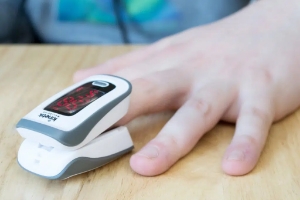
Your oxygen levels are lower than normal. If this is not normal for you, and the readings are likely to be accurate (i.e., there is no nail varnish on, you have been sat still for 5 minutes, your finger is warm, still, and at chest height, and the reading hasn't changed for 5 seconds), this is a sign that you may need to seek urgent medical attention. You can do this by contacting your NHS GP or 111.
Of course, please use emergency services for any life-threatening symptoms as you would do otherwise, by ringing 999 or attending your local A&E department.
What do your results mean?
Your oxygen levels are very low. If this is not normal for you, and the readings are likely to be accurate (i.e., there is no nail varnish on, you have been sat still for 5 minutes, your finger is warm, still, and at chest height, and the reading hasn't changed for 5 seconds), this is a sign that you may need emergency medical attention.
Please recheck your levels immediately and if they stay at 92% or less, (or if you have any other life-threatening symptoms), please ring 999 or attend A&E straight away.
What are the benefits of measuring your SpO2?
NHS advice

by